
Boston Intellectuals · AI Tournament · Harvard University
AI Tournament — Prepare, Then Register
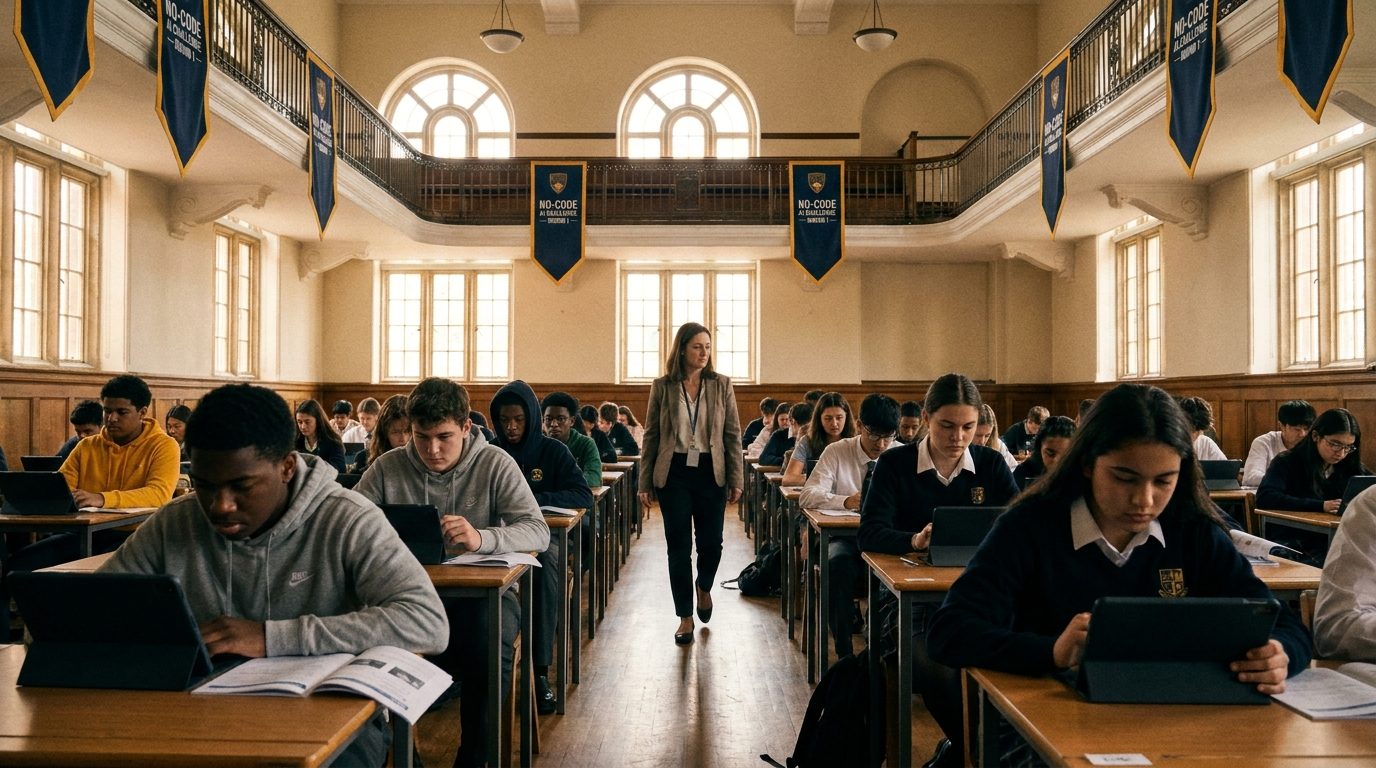
Two tracks: the AI Challenge (proctored rounds — Round 1 needs no coding at all) and the AI Project (build and defend your own AI solution). Work through the many practice questions below — from complete beginner to model-training level — then register at the bottom of this page.
The two tracks explained
AI Challenge: Round 1 tests AI concepts, logic, and math — multiple choice, no coding, no experience required. Round 2 is a practical Python round: real datasets, real models, on your laptop (cloud notebooks provided where needed). AI Project: you build an AI solution to a real problem, submit it in advance, and defend it before judges in a technical interview — exactly like the world's leading AI olympiads.
Try the level check — work through every question
🌱 Beginner — no coding needed (Round 1 level)
Typical: grades 6–8 · curious, zero AI experience
A model learns from 10,000 photos, each labeled "cat" or "dog," to classify new photos. This is an example of:
A) Unsupervised learning B) Supervised learning C) Reinforcement learning D) A rule-based system
Show the answer
B) Supervised learning — the model learns from labeled examples (photo + correct answer). Unsupervised = no labels; reinforcement = learning by reward from actions; rule-based = humans write the rules by hand.
A face-unlock system was trained mostly on adult faces. What will likely happen when children use it, and why?
Show the answer
It will fail more often for children — the training data didn't represent them. This is dataset bias: models are only as fair as their data.
A spam filter marks a real, important email from your teacher as spam. What is this kind of mistake called?
Show the answer
A false positive — the filter said "spam" (positive) when the true answer was "not spam." The opposite (letting real spam into your inbox) is a false negative. Knowing these two words is essential for Round 1.
A team is building a self-driving car. Which of these is NOT training data?
A) Thousands of dashcam videos B) Images labeled "stop sign" C) The car's own future driving decisions D) Photos of roads in rain and snow
Show the answer
C) The car's future decisions haven't happened yet — you can't train on data that doesn't exist. Training data is always collected beforehand. A, B, and D are all valid training data.
You ask an AI chatbot a question and it gives a made-up "fact" that sounds convincing but is completely false. What is this behavior commonly called?
Show the answer
A hallucination — the model generates fluent, confident text that isn't grounded in truth. This is why you always verify AI output against reliable sources. Recognizing this is a core Responsible-AI idea Round 1 rewards.
🌿 Intermediate — concepts + some Python
Typical: grades 8–10 · basic Python, first ML ideas
Your model scores 99% on training data but 62% on new data. What happened, and name two fixes.
Show the answer
Overfitting — the model memorized the training set instead of learning general patterns. Fixes: get more/varied data, simplify the model, use regularization, or hold out a validation set to stop training earlier.
Using pandas, how would you find which column in a dataset has missing values?
Show the answer
df.isnull().sum() — one line, shows the count of missing values per column.
Why do we split a dataset into a training set and a separate test set?
Show the answer
To measure how well the model generalizes to unseen data. If you test on the same data you trained on, a model that simply memorized would look perfect — the test set is the honest check.
In scikit-learn, what does this line do? train_test_split(X, y, test_size=0.2)
Show the answer
It randomly splits your features X and labels y, holding out 20% for testing and keeping 80% for training. It returns four pieces: X_train, X_test, y_train, y_test.
Your image classifier works great in the lab but fails badly on photos taken with a phone camera. Name the likely cause.
Show the answer
Distribution shift (a.k.a. domain shift) — the real-world phone photos differ from the clean training images in lighting, angle, and quality. Fix: train on data that looks like the real deployment conditions.
🌳 Advanced — trains models independently (Round 2 / Project level)
Typical: grades 10–12 · scikit-learn / PyTorch experience
You get a CSV of 5,000 loan applications with 12 features and a yes/no outcome (only 8% are "yes"). Outline your steps to build and honestly evaluate a classifier — and say why accuracy alone is the wrong metric.
Show a strong outline
Split train/test (stratified), handle missing values & encode categoricals, baseline (logistic regression), stronger model (random forest / gradient boosting), evaluate with precision, recall, and F1, not accuracy: predicting "no" for everyone already scores 92% accuracy while catching zero positives. A confusion matrix + ROC-AUC completes the honest picture.
You only have 500 labeled images — too few to train a strong model from scratch. Name two techniques to still get good results.
Show the answer
Data augmentation (flip, rotate, crop, adjust brightness to multiply your effective dataset) and transfer learning (start from a model pretrained on millions of images, then fine-tune on your 500). Both are standard Round-2 moves.
Your model has high precision but low recall. In plain language, what is it doing?
Show the answer
It's cautious: when it does flag something as positive, it's usually right (high precision) — but it misses many real positive cases (low recall). For fraud or disease detection, low recall is dangerous because you let true cases slip through.
A hiring model learned from 10 years of company data and now favors one gender. What's the root cause, and one fix?
Show the answer
Root cause: biased training data — the model learned the historical human bias baked into past hiring. Fixes: remove gender and its proxies (e.g. certain clubs/keywords), rebalance the training data, and audit the model's decisions across groups before deploying. Naming the data (not "the algorithm") as the source is the mature answer.
Judges expect you to explain how you split your data. The standard three-way split looks like this:
Why three parts, not two?
Training teaches the model. Validation is used repeatedly to tune settings (which model, how long to train). Test is touched only once at the very end for an honest final number — if you tune against the test set, you secretly overfit to it and your reported score is a lie. Explaining this cleanly is a fast way to earn judge trust.
🔥 Challenge Question — Read the Confusion Matrix
Advanced · The exact skill judged in Round 2 & project interviews
A student built a model to flag fraudulent transactions. Out of 1,000 test transactions (50 truly fraud, 950 legitimate), the model produced the confusion matrix below. The student proudly reports "95.5% accuracy!" A judge asks: "Is this model actually good at its job?" Study the matrix, then answer.
| Predicted Fraud | Predicted Legit | |
|---|---|---|
| Actually Fraud | 20 (TP) | 30 (FN) |
| Actually Legit | 15 (FP) | 935 (TN) |
TP = caught fraud · FN = missed fraud · FP = false alarm · TN = correct legit
Show the model answer (compute precision & recall first!)
Accuracy = (20 + 935) / 1000 = 95.5% — technically true, but misleading. The job is catching fraud, so compute:
Recall (of real fraud, how much did we catch?) = TP / (TP + FN) = 20 / 50 = 40%. The model misses 60% of actual fraud — terrible for the task.
Precision (of fraud alerts, how many were right?) = TP / (TP + FP) = 20 / 35 = 57%.
So despite 95.5% accuracy, this model lets most fraud through. The high accuracy comes only from the 950 easy "legit" cases. The winning answer names recall as the metric that matters here and proposes fixes: rebalance the data, adjust the decision threshold, or optimize for F1. Seeing past accuracy is what earns the top score.
💻 AI Project track — defend your work
For Project entrants · the technical interview is where projects win
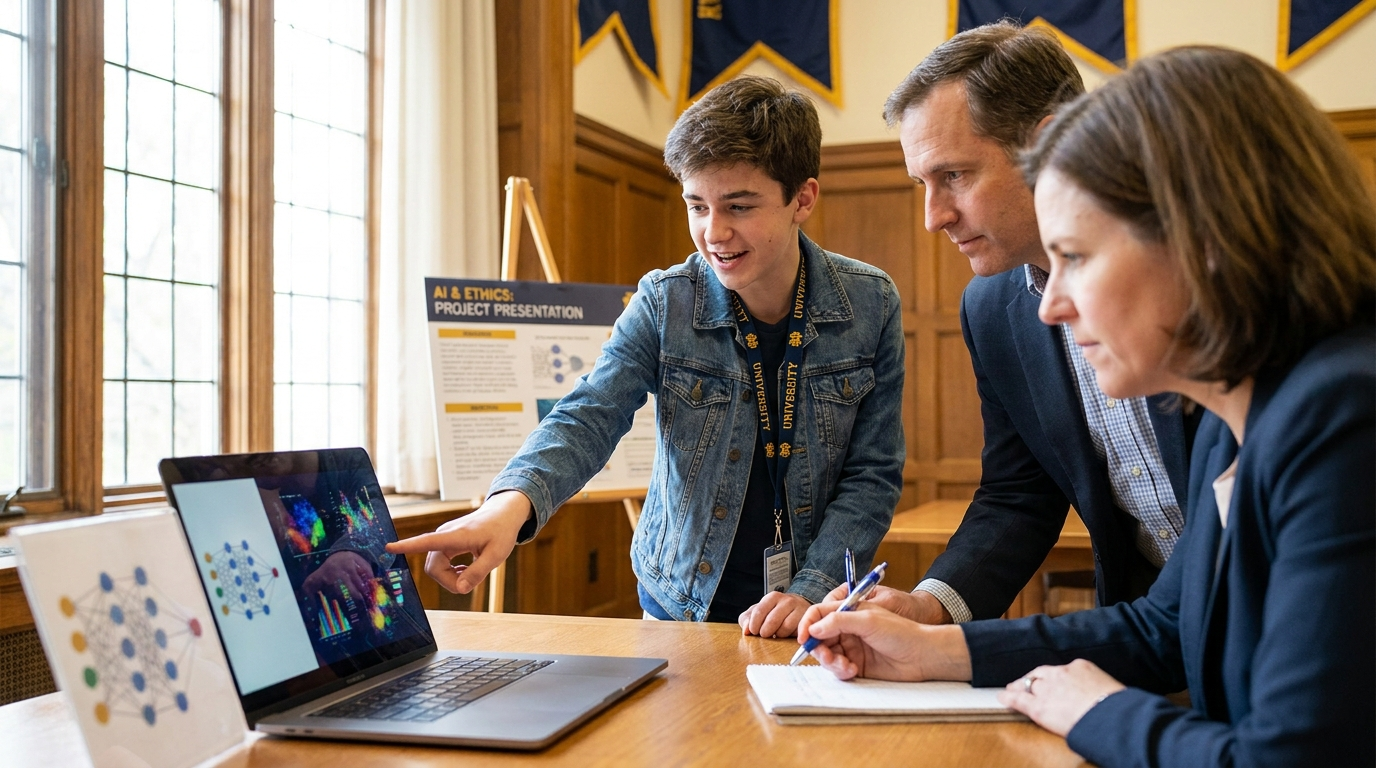
A judge points at your code and asks, "Which part did an AI assistant write?" Why is "I don't remember" a losing answer?
Show the answer
Under our Responsible AI Policy, AI tools are allowed in projects with disclosure — but you must be able to explain every line you submit. "I don't remember" signals you didn't understand your own solution, which is exactly what judges screen out. Know your whole codebase, and disclose your tools up front.
You have 3 minutes to demo your project to judges. Name three things you must show.
Show the answer
(1) The problem — what real need it addresses; (2) a live or recorded result — the model actually working on real input; (3) one honest limitation — where it fails and what you'd fix next. Judges reward honesty about weaknesses far more than a polished claim of perfection.
The Responsible AI Policy — know it before you come
Your 3 days at Harvard
Preparation checklist
- Beginners: finish one free course — "Elements of AI" or Google's ML Crash Course (10–15 hours total)
- Learn the vocabulary: supervised/unsupervised, training vs test data, overfitting, bias, false positive/negative, hallucination
- Intermediate+: practice pandas basics and train one scikit-learn classifier end-to-end with
train_test_split - Practice reading a confusion matrix — compute precision and recall by hand until it's automatic
- Learn the train/validation/test split and why the test set is used only once
- Project track: prepare your repo/demo link, and a written list of every AI tool and dataset you used
- Practice explaining your own code out loud — the technical interview is where projects win or lose
Know your track and level?
Register below to secure your seat.▼