
Boston Intellectuals · Science, Engineering & Robotics Fairs · Harvard University
SER Fairs — Prepare, Then Register
You present an original project — a science investigation, an engineering design, or a robot — to a judging panel. This page shows what a strong project looks like at every level, the exact questions judges ask, and how to write the 250-word abstract that gets you qualified. Then register at the bottom.
How judging works
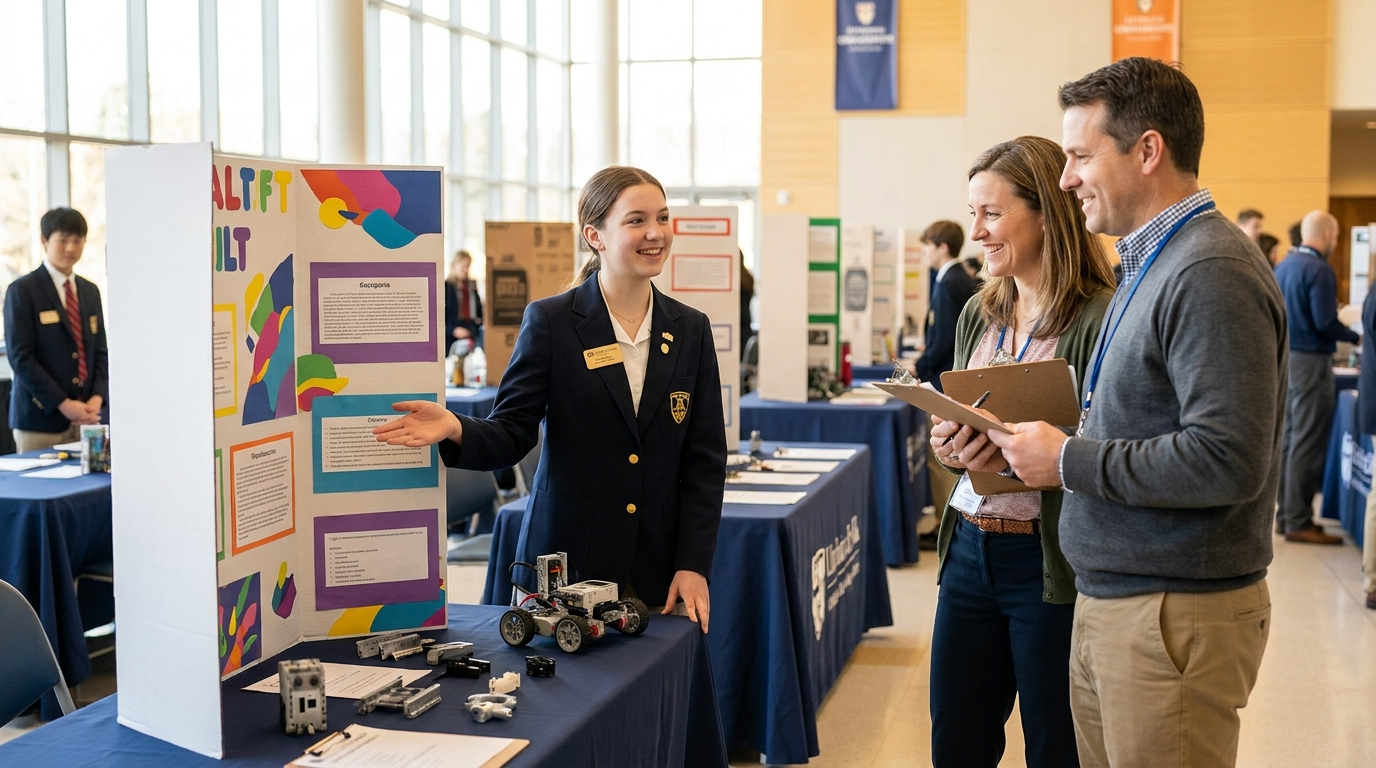
You stand at your display with your project. Judges visit in waves of 10–15 minute interviews: you give a 2–3 minute pitch, then they ask questions. They score the question/problem, method, data & analysis, creativity, and — most heavily — whether YOU understand and did the work. It's a conversation, not an exam.
Classic display layout (three-panel board):
Question
Hypothesis
Background
TITLE
Photos · Charts
Key Results
Analysis
Conclusions
Next Steps
Project levels — set your ambition correctly
🔬 Beginner — first project
Typical: grades 6–8 · school science class experience
Good beginner project examples: "Which paper airplane design flies farthest?" (Engineering) · "Does music tempo affect plant growth?" (Science) · a LEGO SPIKE robot that follows a line (Robotics).
Sample judge question: "Why did you test each design 10 times instead of once?"
What a strong answer sounds like
"One throw could be lucky or unlucky — wind, my arm angle. Ten trials let me average out random error, and I used the average distance to compare designs fairly." Judges hear: this student understands repeated trials and fair testing. That's the beginner gold standard.
⚙ Intermediate — real data, real build
Typical: grades 8–10 · a project with weeks of work behind it
Good intermediate examples: a water-filtration prototype tested with turbidity measurements · an Arduino weather station logging a month of data · a survey study with 100+ responses analyzed with charts.
Sample judge question: "Your filter improved clarity by 40%. How do you know that number is reliable?"
What a strong answer sounds like
"I measured each sample three times with the same sensor, calibrated against clean water. The variation between repeats was about ±3%, so a 40% change is far outside measurement noise." Judges hear: error awareness — the single biggest separator at this level.
🤖 Advanced — research-grade
Typical: grades 10–12 · aiming at top awards and The Finale
Good advanced examples: a machine-learning model detecting plant disease from photos with a confusion matrix · a novel low-cost prosthetic mechanism with force testing · an autonomous robot with sensor fusion and documented failure analysis.
Sample judge question: "What's the biggest limitation of your project, and what would you do next?"
What a strong answer sounds like
"My dataset came from one region, so the model may not generalize — accuracy dropped 12% on outside images. Next I'd collect a multi-region dataset and test cross-validation by location." Advanced students attack their own work honestly. Judges reward it every time.
Safety note: projects with human subjects, vertebrate animals, or hazardous materials pass an additional safety review during qualification — declare honestly on the form.
🔥 Challenge Question — Read the Data Like a Judge
Advanced · The single most-asked judging skill
A student's project claims a new fertilizer "dramatically boosts growth." Below are the actual results: mean plant height after 4 weeks, with error bars showing the spread across 10 plants per group. A judge asks: "Does your data actually support your conclusion?" Study the chart, then answer before revealing the model response.
Show the model answer (this is what wins awards)
"The fertilizer group averaged 3 cm taller — but look at the error bars: they overlap heavily (control 17–27 cm, fertilizer 19–31 cm). With only 10 plants and this much spread, a 3 cm difference could easily be random variation, not a real effect. I cannot yet claim the fertilizer 'dramatically boosts growth' — I'd need a larger sample and a statistical test (like a t-test) to check if the difference is significant."
This is the answer that separates award winners: honest data interpretation beats an exciting-but-unsupported claim every time. Overlapping error bars = not proven yet. Judges love a student who sees it.
The 250-word abstract — your qualification key
Your abstract must cover five parts: (a) the question or problem, (b) your method, (c) data/results, (d) interpretation, (e) conclusions. Compare:
Weak abstract (why it fails)
"I made a robot that sorts recycling. Recycling is very important for the planet. I worked hard on it for two months and learned a lot. The robot is made of LEGO and works well." No method, no data, no results — reviewers can't score it.
Strong abstract (what to copy)
"Household recycling is often contaminated by misplaced items (a). I built ARLO, an Arduino-based sorter using a color + capacitance sensor pair to classify plastic, metal, and paper (b). Across 300 test items, ARLO classified correctly 87% of the time, with metal at 96% and plastic at 79% (c). Most errors came from dark plastics that absorb the sensor light (d). A low-cost dual-sensor design can meaningfully reduce contamination; next, I will add a near-infrared sensor for dark plastics (e)." Five parts, real numbers, honest limitation.
Your 3 days at Harvard
Preparation checklist
- Rehearse your 2–3 minute pitch out loud 10 times, then have someone interrupt with questions
- Know every number on your board: where it came from, how it was measured, and its uncertainty
- Prepare your uploads: research paper (draft is fine), lab notebook pages, 2–5 photos, demo video link
- Practice the "limitation question" — honest self-critique scores highest
- Robotics: bring spare batteries and test your demo on the floor surface type you'll have
- Write the 250-word abstract using the five-part formula above
Project ready and abstract drafted?
Register below to secure your spot.▼