
Boston Intellectuals · Mathematics Tournament · Harvard University
Mathematics Tournament — Prepare, Then Register
Four rounds — Sprint, Target, Team, and Guts — with AMC/AIME-level problems in two divisions (Middle School 6–8 and High School 9–12). Try the samples below to find your level, then register at the bottom of this page.
The four rounds explained
⚡ Sprint
~30 problems, no calculator, pure speed and accuracy. Short answers only.
🎯 Target
Problems in linked pairs (A+B) — your Part A answer feeds Part B. Calculator allowed.
🤝 Team
Your team of 4–6 solves together — communication wins. Individuals get assigned a team.
🔥 Guts
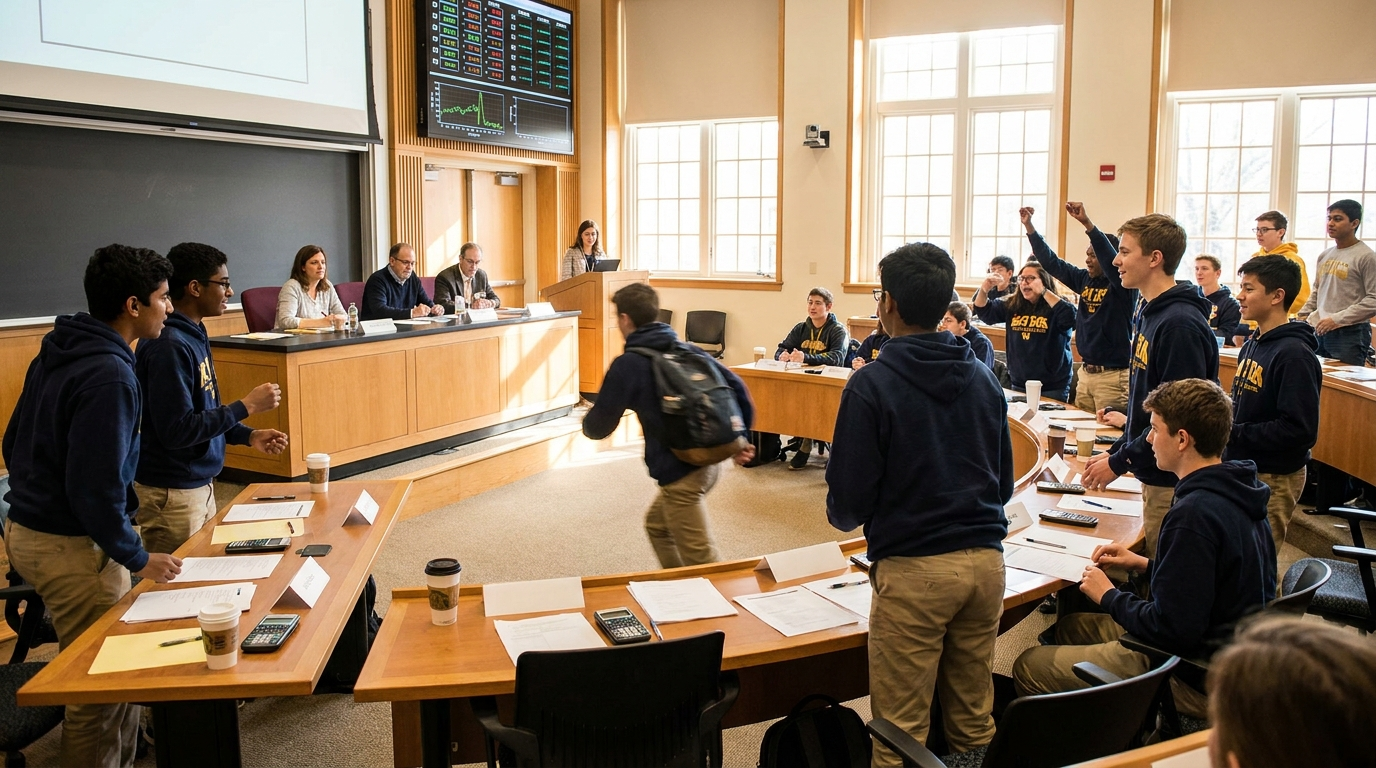
Live-scored relay: run answers to the judges, watch the scoreboard change in real time. Loudest round of the weekend.
Try the level check
➕ Beginner — Middle School, first competition
Typical: grades 6–7 · school-math comfortable
Sprint-style sample: What is the smallest positive number that leaves remainder 2 when divided by 3, and remainder 3 when divided by 5?
Show the solution
List numbers ≡ 3 (mod 5): 3, 8, 13, 18, 23... Check mod 3: 8 = 3·2 + 2 ✓. Answer: 8. (This exact style appears in our qualification questionnaire — explanation matters more than the answer.)
Team-style sample (from the booklet): A rectangular garden has a perimeter of 56 m and an area of 192 m². What are its dimensions?
Show the solution
Half-perimeter = 28, so length + width = 28 and length × width = 192. Solving: 16 m × 12 m.
× Intermediate — MS advanced / HS entry
Typical: grades 8–9 · AMC 8 / early AMC 10 level
Target-style sample (booklet Pair 2A): Let N be the smallest positive integer with exactly 12 divisors. Find N.
Show the solution
12 = 2·2·3, so exponents+1 multiply to 12. Best assignment to small primes: 2²·3·5 = 60 (divisor count (2+1)(1+1)(1+1) = 12). N = 60.
Linked Part B: using N = 60, what is the sum of all prime factors of N² counted with multiplicity?
Show the solution
60 = 2²·3·5, so 60² = 2⁴·3²·5². Sum with multiplicity = 2·4 + 3·2 + 5·2 = 8 + 6 + 10 = 24. (Booklet lists 25; recompute carefully — this is why Target rewards checking your work: 2+2+2+2 + 3+3 + 5+5 = 24.)
∑ Advanced — High School competitive
Typical: grades 10–12 · AMC 10/12 – AIME level
Guts-style sample: If x + 1/x = 4, find x³ + 1/x³.
Show the solution
Cube the identity: (x + 1/x)³ = x³ + 1/x³ + 3(x + 1/x). So 64 = x³ + 1/x³ + 12, giving x³ + 1/x³ = 52.
Target-style sample (booklet Problem 10): For how many integers n with 1 ≤ n ≤ 100 is n³ − n² divisible by 4?
Show the solution
n³ − n² = n²(n − 1). Check n mod 4: it's divisible by 4 whenever n ≡ 0 or 1 (mod 4), and also when n is even (n² carries a factor of 4). Counting all valid n from 1–100 gives 75.
🔥 Challenge Problem — Target Bonus, from the Official Booklet
Olympiad Level · ★ · Geometry + Trigonometry
In triangle ABC, the angle bisector from vertex A meets BC at point D. The circumradius is R = 7, the inradius is r = 3, and the angle at A is 60°. Find the length AD in exact form. This is a real Target Bonus problem from the Freedom Math Tournament booklet.
Show the solution (Olympiad level — try it first!)
AD = 2r / sin(A/2) = 6 / sin(30°) = 6 / (1/2) = 12. The key identity links the inradius, the half-angle at A, and the distance along the bisector. From the booklet's Target Bonus.
Linked Part B: D divides BC in ratio BD:DC = 2:3 with BC = 10, so BD = 4. With R = 7, r = 3, A = 60°, the area of triangle ABC = 21√3, and Area of triangle ABD = (2/5)·21√3 = 42√3 / 5.
How scoring & divisions work
You compete only against your own division (MS 6–8 or HS 9–12). Individual score = Sprint + Target; team awards combine Team + Guts. Awards: gold, silver, and bronze medals, trophies, and cash prizes for champions — every contestant receives a certificate. No prior competition experience is required, and homeschooled students register as independent.
Your 3 days at Harvard
Preparation checklist
- Do 20 minutes of timed problems daily — speed is trainable (AMC 8/10 past papers are free online)
- Practice writing SHORT clean solutions — Target answers must show reasoning
- Drill mental arithmetic: fractions, percentages, squares to 25²
- Learn the classics: arithmetic sequences, counting with cases, remainders (mod), Pythagorean triples, angle bisector & incircle relations
- If joining as a team: practice ONE Guts-style relay together before you arrive
- Draft your questionnaire answers (motivation, achievement, the remainder problem in 5a) in advance
Found your division and level?
Register below to secure your seat.▼