
Boston Intellectuals · Debate Championship · Harvard University
Debate Championship — Prepare, Then Register
World Schools style: squads of 3–5 (3 speak per round), prepared and impromptu motions, points of information, and judging on content, style, and strategy. Work through the sample motions and drills below, then register at the bottom of this page.
Anatomy of a round
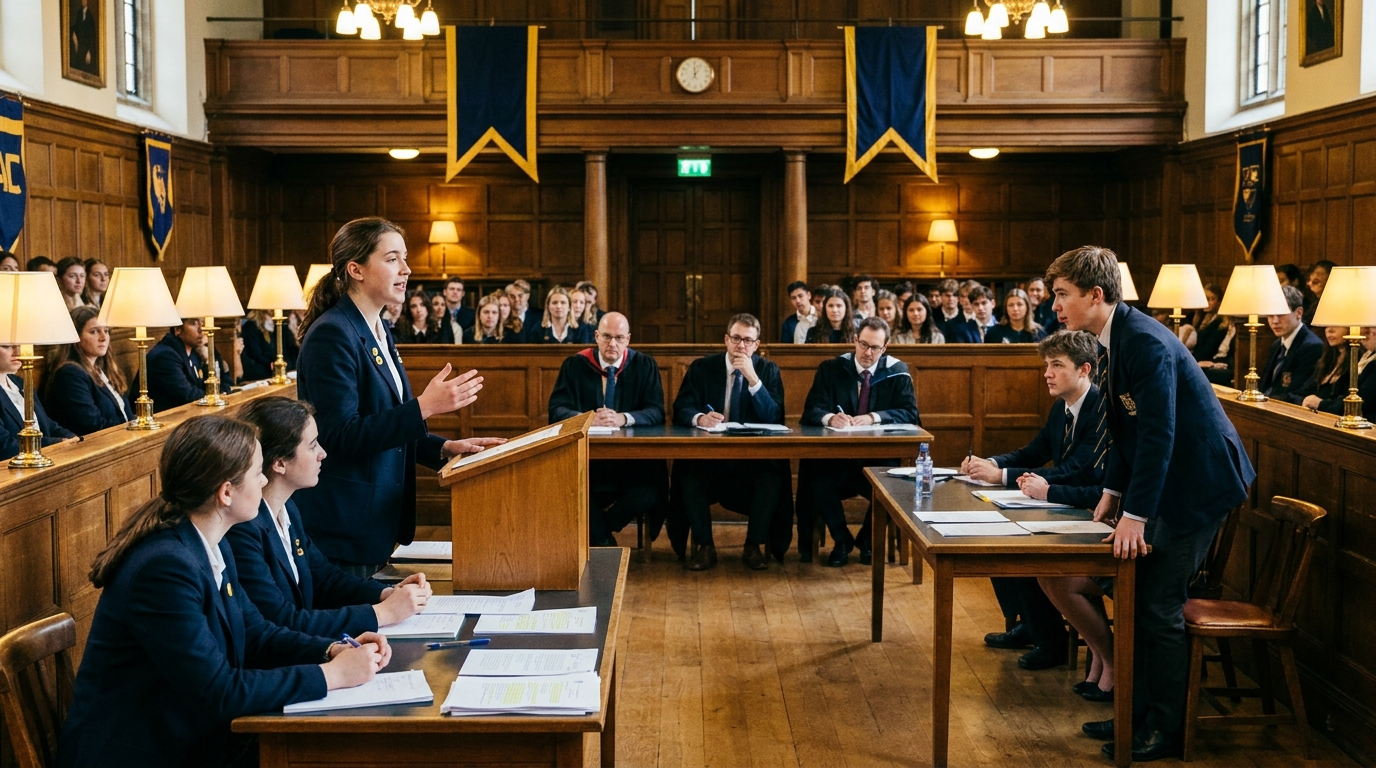
Two teams — Proposition and Opposition — debate a motion beginning with "This House..." Eight speeches: three 8-minute speeches per side, then a 4-minute reply each. 1st speaker defines and builds the case; 2nd rebuts and extends; 3rd summarizes the clash; reply delivers the verdict. During speeches, opponents rise to offer Points of Information (POIs) — 15-second interjections you may accept or decline. Half your rounds are prepared (motion known in advance) and half impromptu (1 hour of prep, team members only).
Practice motions by level
🗣 Beginner — Junior Division entry
Typical: grades 6–8 · first tournament
Learn the PEEL structure for every argument: Point, Explanation, Evidence/Example, Link back to the motion.
See PEEL in action (uniforms, Proposition)
P: Uniforms reduce social pressure. E: When clothes can't signal wealth, students are judged less by what they own. E: Schools introducing uniforms often report fewer appearance-based conflicts. L: Less pressure means a fairer, calmer school — exactly the "good" the motion claims. Four sentences. That's one complete beginner argument.
🎤 Intermediate — Junior advanced / Senior entry
Typical: grades 8–10 · club experience
Rebuttal drill: take the strongest OPPOSING argument on social media ("it connects isolated teens to communities") and attack it in 3 sentences.
See a model rebuttal
"Connection is real — but look at the exchange rate: for every supportive community, the same algorithm serves comparison, outrage, and addiction loops engineered to maximize screen time, not wellbeing. The 'connection' is a byproduct; the harm is the business model. Even if some teens benefit, the motion asks about MOST teens — and the average experience is curated anxiety." Notice: concede what's true, then reframe. That's strategy scoring.
POI drill: your opponent says "banning phones in schools protects focus." Stand and offer a 15-second POI.
See a model POI
"If focus is the goal, why do the countries with the best school results allow supervised device use — isn't the problem management, not the phone?" One pointed question, under 15 seconds, forces a defensive answer.
🏛 Advanced — Senior competitive
Typical: grades 10–12 · tournament experience, aiming for Best Speaker
The steel-man drill (the exact skill our application tests): pick an opinion you hold, then write the most convincing case AGAINST it — champions can be assigned either side of any motion.
How the 60–80 speaker scale reads
70 = solid average speech. 72–74 = clearly strong: organized clash, confident style. 75+ = exceptional. Judges score content, style, and strategy independently, and may not be influenced by their own beliefs about the topic.
🔥 Challenge Exercise — Map the Clash Before You Speak
Advanced · The skill that wins impromptu rounds
Champions don't just list arguments — they predict the opposing case and plan where the debate will clash. Take this motion and, before revealing the map, sketch two arguments for each side and the single biggest clash between them.
Show how a champion uses this map
The winner doesn't argue in parallel — they win the clash. Here, Proposition should preempt the equity attack: "We don't ban overnight — we phase in subsidised alternatives, so the poor are protected AND the ocean is saved." By naming the key clash (environment vs. equity) and resolving it inside their own case, they take the most important ground before Opposition even speaks. Mapping the clash in your 1-hour impromptu prep is what separates finalists from the pack.
Your 3 days at Harvard
Preparation checklist
- Read the news 15 minutes daily — content is one-third of your score
- Practice PEEL until it's automatic; then practice breaking opponents' PEEL
- Record a 2-minute speech on your phone weekly — this doubles as your application video
- Drill POIs both ways: offering sharp ones and answering without losing flow
- Practice clash-mapping: for any motion, predict both sides and name the key clash in 10 minutes
- Run at least two full impromptu hours with your squad before arriving
- ESL/EFL debaters: you compete for main titles AND dedicated awards — register your category proudly
Squad ready and motions drilled?
Register below to secure your place.▼