
Boston Intellectuals · Freedom Chess Tournament · Harvard University
Chess Tournament — Prepare, Then Register
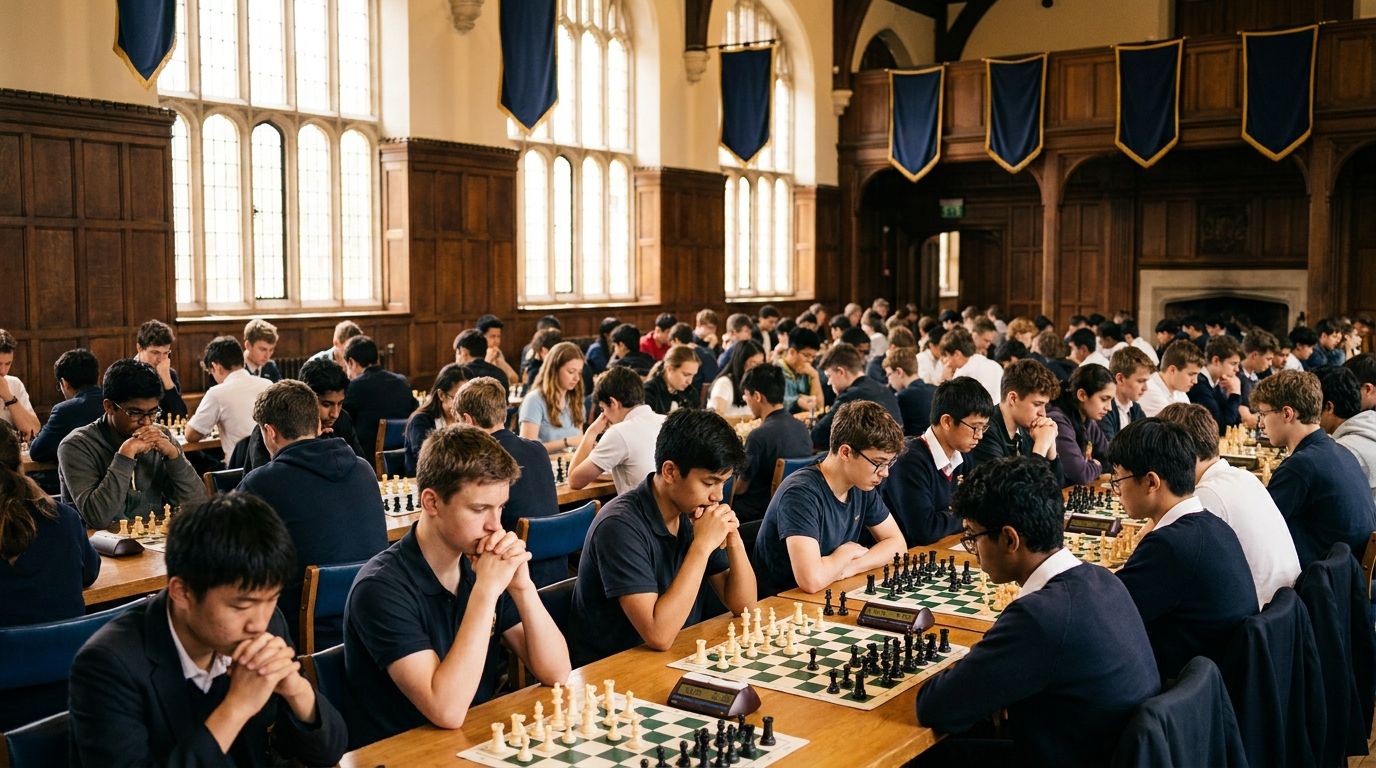
The Freedom Chess Tournament is a 5-round Swiss event (G/30 + 5s increment) in three sections — Open, U1200, U800. Study the samples below to pick your section confidently, then register at the bottom of this page.
How the tournament works
Every player plays 5 games over 3 days against opponents with similar scores (Swiss system — nobody is eliminated). Each player has 30 minutes + 5 seconds per move. You record your moves in algebraic notation, shake hands, and results feed the standings. Trophies go to the top 3 of each section; medals to the Top 10 overall. Between rounds: Harvard visits, workshops, the campus tour, and the Harvard Museum.
Try the level check — which section is yours?
♟ Beginner — U800 Section
Typical: grades 6–8 · learning year 1–2 · unrated
You should know: how every piece moves, castling, check vs. checkmate, and basic notation (e4, Nf3...).
Sample puzzle — White to move, mate in 1:
White: Re1, Kg1 · Black: Kg8, pawns f7 g7 h7
Show the answer
1. Re8# — the classic back-rank mate. Black's own pawns block the king's escape. If you found this, U800 will feel comfortable.
♞ Intermediate — U1200 Section
Typical: grades 7–10 · 2–4 years of play · school club level
You should know: tactics (forks, pins, skewers), opening principles (center, development, king safety), and basic endgames (K+Q, K+R mates).
Sample puzzle — White to move and win material:
White: Nc5, Kg1 · Black: Ke8, Ra8
Show the answer
1. Nd7! forking — the knight leaps to d7, attacking the king on e8 (check) and the rook on a8 at the same time. After the king moves, White captures the rook. Spotting forks quickly = ready for U1200.
Concept question: your opponent brings the queen out on move 2. Name two reasons this usually backfires.
Show the answer
(1) The queen gets chased by minor pieces, losing tempo while you develop; (2) early queen moves neglect the center and king safety — you gain free developing moves by attacking it.
♛ Advanced — Open Section (FIDE rated)
Typical: grades 9–12 · rated players · competitive experience
You should know: calculation of 3–4 move combinations, pawn-structure planning, rook endgames (Lucena & Philidor), and time management at G/30+5.
Sample exercise: in a rook endgame you have K+R+passed pawn on the 7th vs K+R. Your king is cut off in front of the pawn. Name the winning technique and its first key idea.
Show the answer
The Lucena position ("building a bridge"): advance your rook to the 4th rank, then shelter your king from checks by interposing the rook — Rf4, Ke7→f6, and after the checks run out, the rook blocks on the file and the pawn promotes. Every Open-section player should execute this in under a minute.
🔥 Challenge Puzzle — from the Official Tournament Booklet
Advanced · Open Section · ★★★★ · 25 points
Queen Sacrifice. White to move. This position requires a stunning queen sacrifice to expose the Black king. Calculate at least 4 moves deep — the answer is a piece sacrifice followed by a forced mating attack. This is a real puzzle from the Freedom Chess Tournament competition booklet.
White: Ne5, Bd3, Be3, Qe2, Nd2, Rf1, Ra1, Kg1, pawns a2 b2 c3 d4 f2 g2 h2 · Black: Kg8, Qd8, Ra8, Rf8, Be7, Nc6, Nf6, pawns a7 b7 c5 d5 e6 f7 g7 h7
Show the solution (try it first — 4 moves deep!)
1.Qxh7+!! Kxh7 2.Ng4+ Kg6 3.Be4# (or 3.Nf4#) — White sacrifices the queen to drag the king into the open, and the two bishops plus knight deliver a forced mate. This is the level of calculation the Open section rewards.
What the arbiters & reviewers look for
Correct notation and clock handling, sportsmanship (handshake, silence, no phones in the hall), honest section choice — organizers may reassign sections during qualification review — and in the questionnaire: clear reasoning in your own words.
Your 3 days at Harvard

Preparation checklist
- Solve 10–15 tactics puzzles daily (lichess.org or chess.com — free)
- Play practice games at 30-minute time control — not just blitz
- Learn/refresh algebraic notation — you must record your games
- Master the two mates: K+Q vs K and K+R vs K, with 1 minute on the clock
- Prepare one opening for White and one defense for Black — ideas over memorization
- Answer the questionnaire draft (motivation, achievement, 5a) before opening the form
Studied the samples and know your section? Register below to secure your seat.